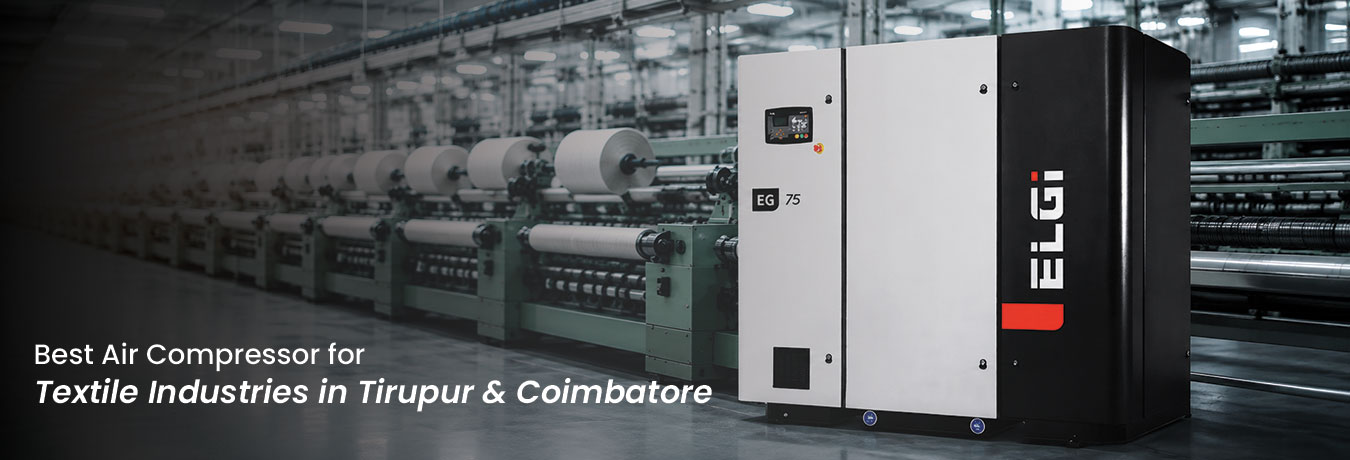
Best Air Compressor for Textile Industries in Tirupur & Coimbatore
Tirupur and Coimbatore are among Tamil Nadu’s most important textile and manufacturing hubs. From spinning and weaving to dyeing, knitting, garment production and finishing, compressed air plays an important role in several textile processes.
Choosing the best air compressor for textile industries is therefore not simply about selecting a machine with the highest capacity. Textile manufacturers need to consider air quality, pressure requirements, operating hours, energy consumption, reliability, maintenance and the overall compressed air infrastructure. For textile manufacturing units, selecting the right air compressor for textile industry applications can improve productivity while helping control long-term operating costs.
Why Is Compressed Air Important in the Textile Industry?
Compressed air is used across different stages of textile manufacturing. Depending on the process, it may be required for pneumatic equipment, actuators, control systems, air jets, cleaning applications and automated machinery. In spinning and weaving operations, consistent compressed air is particularly important because fluctuations in pressure or inadequate air quality can affect machine performance. For textile mills in Tirupur and textile industries in Coimbatore, compressors often operate for long hours. This makes compressor efficiency and reliability particularly important when calculating the overall cost of production. A well-designed compressed air solution should therefore provide the required air volume and pressure consistently without unnecessary energy consumption.
What Makes the Best Air Compressor for Textile Industries?
There is no single compressor that is ideal for every textile facility. The right choice depends on the manufacturing process, air demand, operating conditions and production scale. However, some important characteristics should be considered when selecting a textile industry air compressor.
1. Consistent Air Pressure
Textile machinery requires stable compressed air to operate effectively. A compressor should be capable of maintaining the required pressure even when demand varies throughout the production cycle. A properly sized rotary screw air compressor can be a suitable choice for applications requiring continuous and reliable compressed air.
2. Energy Efficiency
Energy can represent a significant portion of the operating cost of an industrial compressor, particularly in textile plants where equipment may run continuously. An energy efficient air compressor can help reduce power consumption while delivering the required compressed air output. When comparing compressor models, manufacturers should look beyond the initial purchase price and evaluate lifecycle operating costs, specific power consumption and efficiency at different load conditions. Variable-speed technology can also be considered where the plant's compressed air demand fluctuates.
3. Appropriate Air Quality
Air quality is another important consideration. Depending on the textile process, oil contamination may need to be carefully controlled. An oil-free air compressor may be appropriate for applications where oil-free compressed air is required. However, not every textile application necessarily requires an oil-free system. The compressor should therefore be selected according to the actual air-quality requirements of the manufacturing process.
4. Correct Compressor Capacity
Oversizing or undersizing a compressor can create unnecessary costs. An undersized compressor may struggle to meet peak demand, resulting in pressure drops and reduced machine performance. An oversized compressor, on the other hand, may operate inefficiently and consume more energy than necessary. A detailed assessment of current and future air demand can help identify the appropriate compressor capacity.
The Importance of a Compressed Air Piping System
Selecting the right compressor is only one part of an efficient compressed air installation. The compressed air piping system also has a direct impact on pressure losses, air distribution and overall efficiency. Poorly designed piping, undersized pipes, excessive bends and leaks can cause pressure drops and force compressors to work harder. For textile plants, the compressed air network should be designed according to the plant layout, air demand and future expansion plans. A professional industrial air compressor supplier can evaluate the entire compressed air network rather than focusing only on the compressor.
Why Consider Rotary Screw Compressors for Textile Applications?
A rotary screw air compressor is widely used in industrial environments where continuous compressed air is required. Compared with intermittent-duty compressor applications, textile manufacturing can involve long operating hours and relatively consistent demand. Rotary screw technology can therefore be suitable for many textile applications. The exact configuration should depend on factors such as required flow, pressure, duty cycle, air quality and operating environment. For larger plants, multiple compressors may also be considered instead of relying on a single machine. This can provide greater flexibility during maintenance and changing production requirements.
Air Compressor Maintenance: A Key Factor
Even the best air compressor for textile industries will not perform efficiently without regular maintenance. Routine air compressor maintenance can help identify issues before they lead to production interruptions. Maintenance requirements may include checking filters, oil levels where applicable, separators, belts, cooling systems, valves and other components according to the manufacturer's recommendations.
Compressed air leaks should also be identified and repaired regularly. A small leak may appear insignificant, but multiple leaks across a large textile facility can result in substantial energy wastage. Preventive maintenance can therefore support equipment reliability and help extend compressor service life.
How Air Audit Services Can Improve Efficiency
Before purchasing a new compressor or upgrading an existing system, textile manufacturers can consider air audit services. An air audit evaluates how compressed air is being generated, distributed and consumed within the facility. It can help identify:
- Excessive compressed air consumption
- Pressure losses
- Air leakage
- Inefficient compressor operation
- Inappropriate operating pressure
- Opportunities for energy savings
- Potential improvements to the compressed air network
For textile mills in Tirupur and manufacturing facilities in Coimbatore, an air audit can provide useful data for making equipment and infrastructure decisions.
Choosing an Air Compressor Supplier in Tirupur & Coimbatore
When selecting an industrial air compressor supplier, consider more than the brand and machine specifications.
Look for a supplier that can provide:
- Compressor selection based on actual plant requirements
- Installation and commissioning support
- Compressed air piping solutions
- Preventive maintenance
- Spare parts availability
- Technical support
- Energy-efficiency assessments
- Air audit services
For businesses searching for an air compressor dealer in Tirupur or a textile air compressor supplier in Coimbatore, local technical support can be particularly valuable because textile plants often require timely service to minimise production downtime.
Making the Right Investment for Your Textile Plant
The best air compressor for textile industries is ultimately the one that matches your plant's specific compressed air requirements while delivering reliable and efficient operation. Whether you are setting up a new textile manufacturing facility, expanding an existing plant or replacing an ageing compressor, evaluate the complete system rather than considering the compressor in isolation. A properly selected rotary screw air compressor, supported by an efficient compressed air piping system, regular air compressor maintenance and periodic air audit services, can contribute to better energy management and reliable production.
For textile manufacturers in Tirupur and Coimbatore, investing in the right compressed air solutions can therefore be an important step towards improving operational efficiency, reducing avoidable energy losses and supporting long-term production performance.
Share This Story, Choose Your Platform!


